


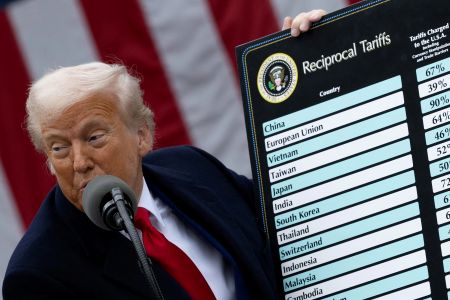
Supreme Court strikes down Trump’s tariffs in major setback for president.
The Supreme Court dealt a major blow to President Donald Trump’s economic agenda, ruling that he does not have the authority to impose sweeping tariffs at the stroke of a pen.
On Friday February 20, 2026, the court tossed the tariffs that are the centerpiece of his economic policy and a major foreign policy tool – but that have also raised costs for consumers and businesses. It is the first major ruling against Trump’s controversial expansive view of presidential power.
“The President asserts the extraordinary power to unilaterally impose tariffs of unlimited amount, duration, and scope,” Chief Justice John Roberts wrote in the 6-3 opinion. “In light of the breadth, history, and constitutional context of that asserted authority, he must identify clear congressional authorization to exercise it.”
Trump, Roberts concluded, cannot.
‘They are clearly lawful’
In a dissent joined by Justices Clarence Thomas and Samuel Alito, Justice Brett Kavanaugh called tariffs a “traditional and common tool to regulate importation” that the law gives to the president.
“The tariffs at issue here may or may not be wise policy,” Kavanaugh wrote. “But as a matter of text, history, and precedent, they are clearly lawful.”
And he said the majority’s decision “says nothing” about whether and how the government must return the billions of dollars already collected.
Tariffs struck down
The decision could quiet some critics who’ve complained that the court – which has a 6-3 conservative majority – has allowed Trump to make major policy moves without authorization from Congress after it blocked big initiatives of President Joe Biden, a Democrat.
Trump had been counting on the tariffs to boost the federal budget by more than $2 trillion over the next decade and bring manufacturing back to the United States.
The president had warned the court that striking down his tariffs would have “catastrophic consequences for our national security, foreign policy and the economy.”
But administration officials have also noted they have alternate means of imposing import fees and promised to move quickly to use them.
That means the uncertainty about operating costs is likely to persist for retailers and other businesses even as they celebrate the decision that Trump can’t use a 1977 emergency powers law to sidestep a more complex and limited tariffs process laid out in other laws.
Tariffs are paid by companies when they import goods from other countries. In anticipation of the ruling, thousands of companies filed lawsuits to try to obtain refunds.
Trump relied on emergency law
The 1977 International Emergency Economic Powers Act, passed after the Watergate scandal during a time when Congress wanted to reign in executive power, has historically been used to impose economic sanctions and other penalties on foreign countries. But the administration argued that the authority the law gives presidents to “regulate” importation in response to an “unusual and extraordinary threat” includes the power to impose tariffs.
Beginning in early 2025, Trump used the law to impose tariffs on almost all goods imported into the United States to reduce persistent trade deficits, which he says have hollowed out the nation’s manufacturing base.
Trump used other tariffs he imposed on goods imported from Mexico, Canada and China as leverage to get those countries to do more to stop fentanyl from coming into the United States.
Small businesses took on Trump
Multiple small businesses and a dozen states with Democratic attorneys general sued the administration.
They argued that Trump stretched the word “regulate” beyond its plain meaning. If “regulate” means “tax,” they said, then a president “could tax everything from autos to zoos,” even though the Constitution gives Congress the power to raise revenue.
During the November oral arguments, the Justice Department described the tariffs as “regulatory,” imposed for foreign and domestic policy reasons rather than to boost the government’s coffers. But Trump had also bragged about tariffs being a substantial revenue raiser.
Still, the administration argued that Congress wanted presidents to have major power over international trade during an emergency and that’s appropriate because the Constitution gives presidents broad authority in foreign affairs.
Roberts, however, said that when Congress has delegated its tariff powers, it has done so in explicit terms, and subject to strict limits.
“What common sense suggests, congressional practice confirms,” he wrote.
Lower courts sided with the challengers, although the U.S. Court of Appeals for the Federal Circuit was divided.
Polls consistently show that the tariffs are unpopular.
The cases of Learning Resources v. Trump and Trump v. V.O.S. Selections were the first time a challenge to a policy Trump enacted during his second term got a full hearing at the Supreme Court. Until deciding those cases, the justices had issued only interim decisions about whether Trump’s policies could remain in effect while they’re being litigated. In those temporary rulings, Trump has been overwhelmingly successful.
Maureen Groppe