


Trump to push for ’emergency’ electricity auction, underlining the difficult politics of rising utility prices and AI.
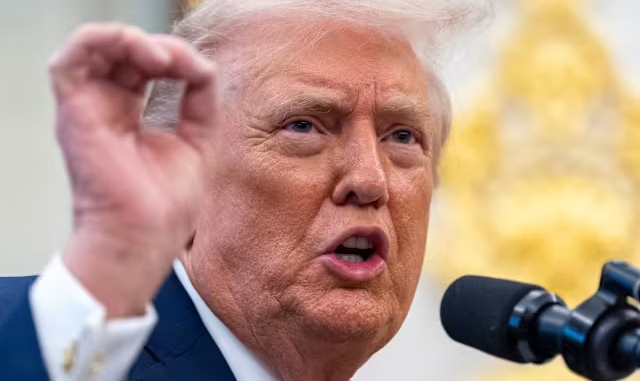
The White House is reportedly set to announce a new action on Friday January 16th, 2026, that will attempt to make Big Tech companies “pay their own way,” as President Trump put it earlier this week, when it comes to energy consumption in the years ahead.
The reported plans are for a new “emergency wholesale electricity auction” that would seek to lock large tech companies into long-term energy contracts to fund AI-fueled demand on power grids.
Big Tech’s rapid expansion has contributed to rising electricity prices for consumers and emerged as a key political vulnerability for Trump and other Republicans.
The plan appears to be for contracts that would force these companies to pay for a set amount of power, whether they consume the electricity or not. That could then provide a higher and steadier revenue stream to flow to grid operators and encourage more power generation.
The plans were outlined to Bloomberg and Reuters. A White House official didn’t immediately respond Friday morning to confirm the plan or offer additional details.
The statement of principles being signed isn’t expected to be a binding legal document, but it’s clearly a bipartisan worry: A mix of governors, including Democratic Pennsylvania Gov. Josh Shapiro and Republican Virginia Gov. Glenn Youngkin, are expected to be at the White House Friday.
But key details remain unclear. The plan appears to hinge on compelling PJM Interconnection — the largest power grid operator in the United States — to sell the contracts without apparently consulting PJM itself.
A company spokesperson confirmed to Yahoo Finance Friday morning that “PJM was not invited to any event at the White House today and therefore we would not be there.”
Differing views of possible solutions to a growing problem
PJM’s auctions have emerged as a controversial topic in recent months.
A collection of state governors, many of whom appear set to be at the White House today, wrote a letter last Summer saying that the company “faces an unprecedented crisis of confidence.”
Trump also crystallized the political issue before him in a Truth Social post earlier this week. He bemoaned utility price increases (blaming President Biden while ignoring significant new price hikes over the past year) and added, “I never want Americans to pay higher Electricity bills because of Data Centers.”
The president is right that the average price of electricity in US cities has been on the rise for years, but that figure jumped over 5% between January 2025, when he took office, and this past December, according to the government’s Bureau of Labor Statistics.
It’s also unclear for the moment whether Trump and Big Tech giants are on the same page.
Trump and various CEOs have expressed a desire to limit the effect of data centers on local electricity prices but have offered very different definitions of what actions they will take in response.
In Trump’s telling, as he said during a speech in Detroit this week, “they’re going to own their own electric, they’re becoming their own electricity producer,” and perhaps even sell access back to the grid.
Meanwhile, the plan being announced today appears somewhat different and more about instituting changes to the existing PJM grid, which covers 67 million people in the eastern US, and forcing data center operators to put money down to help others expand the grid.
At least one CEO has outlined yet another plan to avoid price increases. Microsoft (MSFT) President Brad Smith delivered a speech in Washington this week where he described how his company will work with local utilities and “bear the cost” of increasing transmission capabilities to get electricity from further away to meet data center demand.
“I think the bare minimum, as we look to the future, is to give these communities around the country the confidence that when a data center comes, its presence will not raise their electricity prices,” Smith said.
Meta (META), meanwhile, made a recent move to head off the issue by announcing plans to partner with nuclear energy companies to “help add clean, reliable energy to electric grids,” including “power to the grids that support our operations.”
A growing bipartisan issue
Rising utility prices are at the center of affordability concerns that are already weighing on Republicans’ effort to maintain control of Congress this November.
But the issue isn’t new. Trump repeatedly promised on the 2024 campaign trail that he would focus on lowering electricity prices.
“We will cut it in half, and that includes your heating, air conditioning, electricity, gasoline for the cars,” he promised an audience in Wisconsin in September 2024. “And we’ll do it easily; you can hold me to it.”
Prices have instead moved in the opposite direction. The political problem, meanwhile, keeps growing and is even expected to weigh on the 2028 presidential contest.
This issue has emerged as a notable fissure among Republicans. Florida Gov. Ron DeSantis recently emerged as an outspoken voice saying that federal government preemption of AI laws — an effort Trump has championed — wouldn’t allow states to combat issues like “data center intrusions on power/water resources,” calling it “federal government overreach.”
DeSantis and New York’s Democratic governor, Kathy Hochul, rarely agree on much, but she has offered a similar message. In her State of the State address this week, she announced a new effort called the Energize NY Development initiative that she says will force large data centers to either generate their own electricity or pay more for energy from the grid.
“Massive data centers are driving up electricity demand faster than the grid can keep up,” she said.
Ben Werschkul is a Washington correspondent for Yahoo Finance.